

physician resources
Could it be Biliary Tract Cancer?
Gastroenterologists and endoscopy specialists are often among the first clinicians to encounter signs of biliary tract cancer (BTC), including unexplained biliary obstruction, abnormal liver tests, and indeterminate biliary strictures.
Recognizing potential warning signs and considering BTC early can help move patients toward appropriate imaging, tissue diagnosis, biomarker testing, and multidisciplinary evaluation.

LEARN MORE
When should you consider BTC?
Biliary tract cancer can present with a range of symptoms and clinical findings. Consider BTC when patients present with:

Jaundice, itching, dark urine, or pale stools

Right upper quadrant or epigastric pain

Unexplained weight loss or abnormal liver tests

Elevated ALP, GGT or CA 19-9

Biliary dilation without a visible stone

Focal or indeterminate biliary strictures
Certain risk factors, including primary sclerosing cholangitis (PSC), longstanding inflammatory bowel disease, cirrhosis, and hepatolithiasis, may further raise suspicion.
A key consideration: Not all patients present with obvious biliary obstruction. Some may have nonspecific symptoms or incidental abnormalities.
If You See…
One or more of the following clinical findings:
| Presenting Features | Supporting Findings |
| Jaundice or pruritus Dark urine or pale stools RUQ or epigastric pain Unexplained weight loss Incidental abnormal LFTs | Elevated ALP/GGT ± bilirubin Elevated CA 19-9 Biliary dilation without a visible stone Focal or indeterminate stricture |

Consider BTC
Especially when one or more risk factors are present, including PSC, longstanding IBD, cirrhosis, or hepatolithiasis.
Take Action
- State clinical suspicion
Include “clinical suspicion of biliary tract cancer” on the referral. - Define anatomy
Obtain dedicated imaging (MRCP/CT). - Secure adequate tissue
Obtain biopsy/brushings through ERCP, EUS-FNB, or a percutaneous approach. Consider histology and biomarker testing. - Connect to a multidisciplinary team.
Our specialist map is here. Support early review of staging and resectability, with appropriate subspecialty referral.
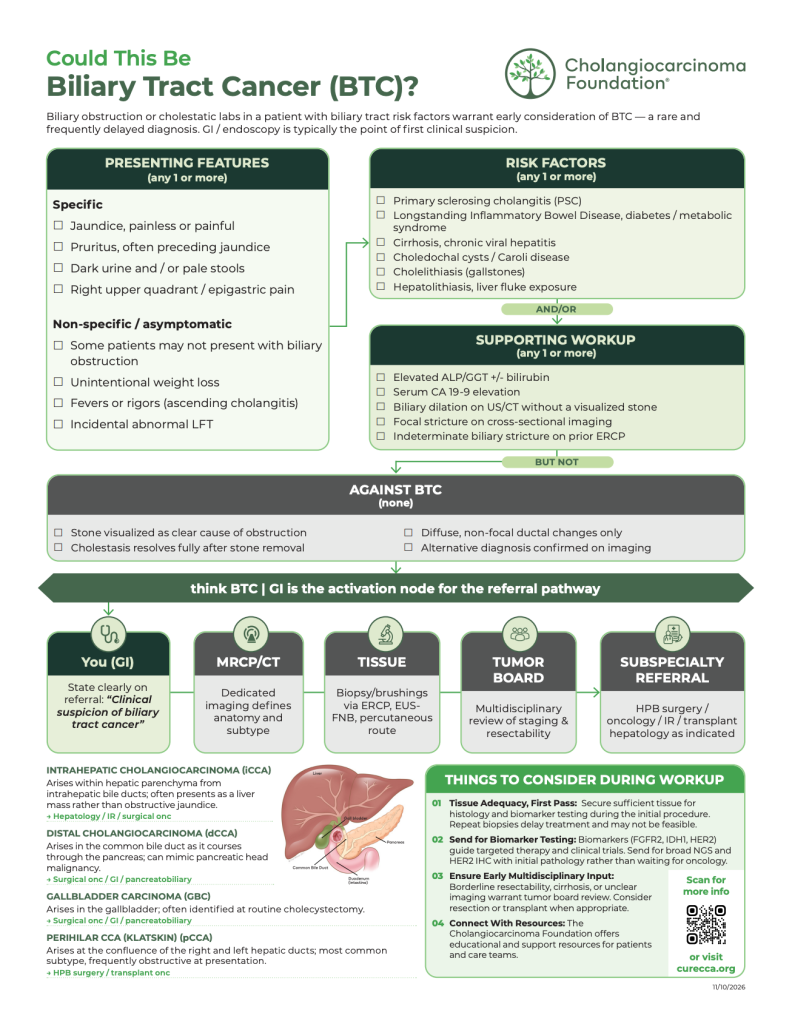
Your role in the diagnostic pathway
GI practitioners play an important role in identifying potential BTC and initiating the referral pathway.
Early consideration of BTC can help support:
- Appropriate cross-sectional imaging, including MRCP or CT
- Adequate tissue collection for histology and biomarker testing
- Early multidisciplinary review of staging and resectability
- Timely referral to hepatobiliary surgery, oncology, interventional radiology, or transplant specialists, as appropriate
Download the clinical reference for a quick overview of presenting features, risk factors, diagnostic considerations and the referral pathway.
Additional Resources
Navigating Cholangiocarcinoma Book
A practical guide to help patients and caregivers better understand a diagnosis, treatment options, and the questions to ask along the way.
Explore the book →
Regional Symposia
Connect with other experts, researchers, clinicians, and the cholangiocarcinoma community through educational events and regional meetings.
Find a Regional Symposium →